How much account overlap makes a partnership worth pursuing?
TL;DR
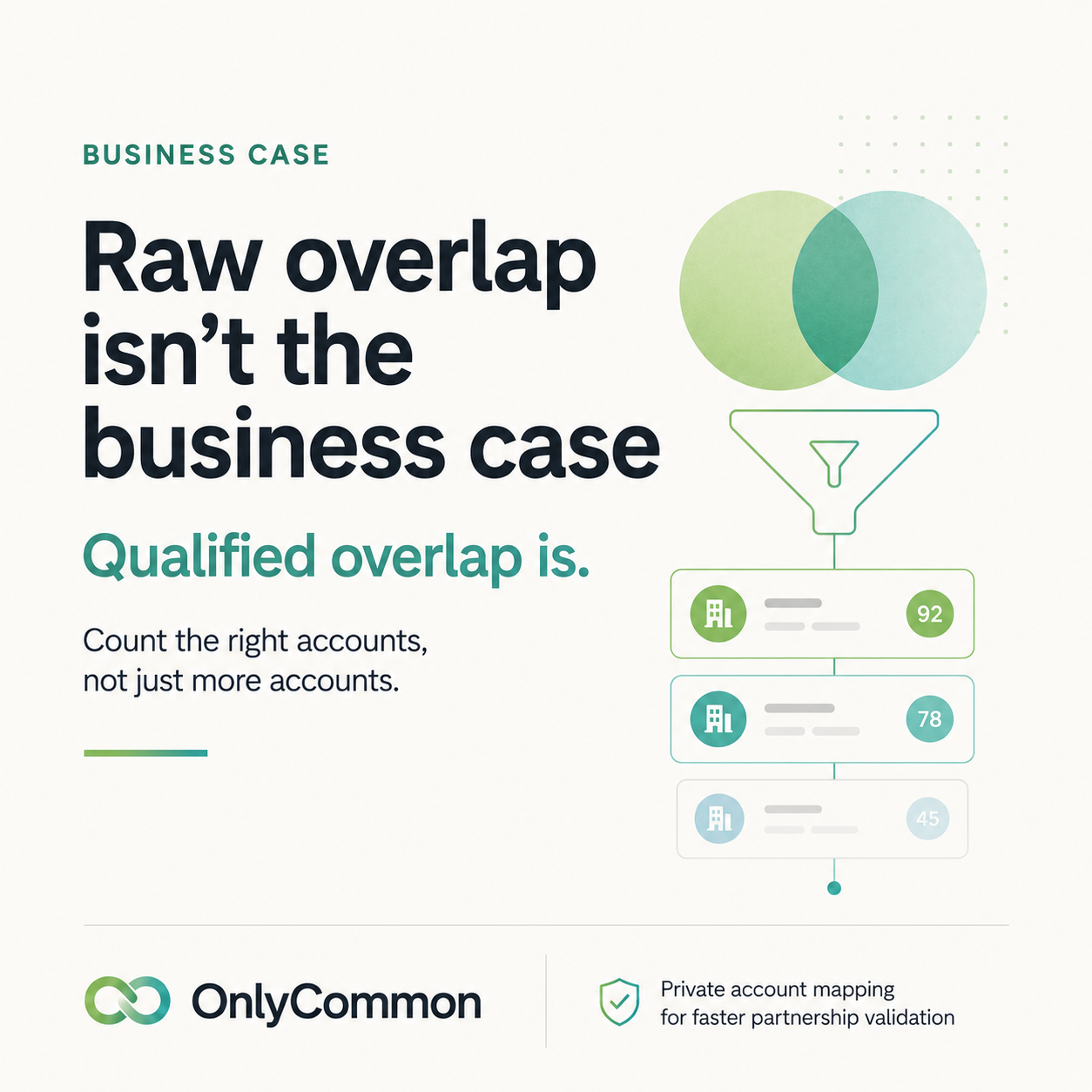
Raw overlap count alone doesn't tell you whether a partnership is worth pursuing. What matters is the quality of the overlap: how many are immediate opportunities, shared customers, or strategic targets, and whether the account owners will actually engage. A useful rule of thumb — not a universal threshold — is enough qualified overlap to select a 3–10 account pilot, which usually means a larger raw pool. A few high-value strategic accounts can also justify a partnership. Score the overlap set, then decide to expand, reshape, or stop.
Why the raw number doesn't decide it
The first question every partnership lead asks after a mapping session is "how many did we overlap on?" It's the wrong first question. Two partnerships with the same 60-account overlap can have wildly different value:
- Partnership A: 60 shared accounts, 45 of them are old logos neither side is actively working, 10 are outside your ICP, and 5 are active opportunities but the account owners on both sides have never spoken.
- Partnership B: 60 shared accounts, 20 are current customers ripe for expansion, 15 are open opportunities on either side, and 5 are strategic logos both teams have been trying to reach.
Same headline number, very different partnerships. Quality of overlap beats volume every time.
The four categories of overlap
Every shared-account list is a mix of four categories. Naming them changes the conversation.
1. Immediate opportunities
Accounts where one side has an open, active opportunity and the partner has an existing relationship — a champion, a live contract, or a trusted vendor status. These are the fastest wins in a pilot. A handful of these can carry a partnership on their own.
2. Shared customers
Accounts where both sides are already a paid vendor. High expansion and retention leverage — joint success stories, joint QBRs, and cross-sell into departments neither side reaches alone. Undervalued by most teams because there's no obvious "new deal" attached.
3. Strategic target accounts
Accounts on your target list where the partner has a real relationship you don't. These are the warm-intro plays: a few well-worked strategic accounts can justify an entire partnership even if the raw overlap number looks small.
4. Incidental overlap
Accounts that appear on both lists but aren't a fit for either side's current motion — wrong segment, dormant customer, exited relationship, out-of-geography, or already-lost opportunity. These pad the headline number without producing anything. Ignore them, or set them aside for a future motion.
A useful first pass on any mapping report is bucketing every shared account into one of these four categories. The categories drive the pilot; the raw count doesn't.
Evaluation criteria for each account
Scoring the overlap requires more than the four buckets. Nine criteria matter in practice.
- ICP fit. Segment, size, industry, use case. Non-fit accounts don't get better because a partner also sells to them.
- Active opportunity status. Is there an open opportunity on either side, and at what stage?
- Relationship strength. Does the partner have a champion, a paid contract, a trusted vendor status, or just a name in a CRM?
- Customer / prospect status. Current customer, expansion target, open opportunity, or cold prospect.
- Product relevance. Does the joint value proposition actually apply to this account's use case, or is it a stretch?
- Geography. Same region, or split across regions with no coordinated coverage?
- Timing. Is there a compelling event — renewal, RFP, budget cycle — in the next 90 days?
- Account owner engagement. Will the named AE on your side actually work this account with a partner? Will theirs?
- Strategic value. Would a win on this account move the business — reference logo, breakthrough segment, competitive displacement?
A handful of accounts scoring well across most of these is worth more than dozens of accounts scoring poorly.
A practical rule of thumb (not a universal threshold)
There's no universal number of shared accounts that guarantees a partnership is worth pursuing. Anyone who tells you "you need N overlaps to justify a partnership" is oversimplifying.
A more honest rule of thumb: you need enough qualified overlap to select a 3–10 account pilot. Because most raw overlap sets contain incidental noise, the raw pool usually needs to be several times larger than the pilot itself. In practice, teams often find they want 20+ shared accounts to comfortably pick a strong pilot of 5–10, but this varies significantly by segment, ICP tightness, and how mature both companies' target lists are.
Two important nuances:
- A few strategic accounts can still justify a partnership. If the partner has a real relationship at 3 strategic logos you've been unable to crack, that alone can be worth an entire program — the raw count is irrelevant.
- A big overlap of low-quality accounts can be less valuable than a small overlap of high-quality ones. Volume without fit is not evidence.
Use the rule of thumb as a starting point, not a decision rule.
A simple scorecard
A lightweight scorecard for judging an overlap set. Score each dimension 1–5.
| Dimension | 1 | 3 | 5 |
|---|---|---|---|
| Immediate opportunities | 0 | 3–5 | 6+ |
| Shared customers with expansion potential | 0 | 3–5 | 6+ |
| Strategic targets with partner relationship | 0 | 2–3 | 4+ |
| ICP fit of the shared set | Weak | Mixed | Strong |
| Account-owner engagement (both sides) | Passive | Interested | Committed |
| Compelling events in next 90 days | None | 1–2 | 3+ |
| Executive sponsorship on both sides | Absent | Emerging | Confirmed |
Rough interpretation:
- 28+ (out of 35): expand. Run a full pilot on a well-chosen 5–10 accounts. Bring the business case to leadership.
- 17–27: reshape. Real potential but something's missing — segment, timing, relationship depth, or ownership. Tighten the hypothesis and re-map, or run a mini-pilot on 3 accounts to build evidence.
- Below 17: stop or defer. The overlap doesn't justify the internal capacity a full pilot requires. Redirect the effort to a partner with more evidence.
Adjust the thresholds to your context; the scorecard is a discipline, not a formula.
Expand, reshape, or stop
Every mapping session should end with an explicit decision.
Expand
The overlap is real and well-distributed across immediate opportunities, shared customers, or strategic targets. Move to a 60-day pilot on 3–10 named accounts, with named owners on both sides. See how to validate a B2B partnership before investing in it and partner activation.
Reshape
There's signal but not enough to fund a full pilot. Common reshapes: narrow the ICP hypothesis, focus on a specific segment or geography, re-map after adding a target-account list rather than a customer list, or run a 3-account mini-pilot to prove the motion before expanding.
Stop
The overlap is thin, incidental, or not a fit for the joint motion. Say so clearly, deprioritize the partnership, and move on. Stopping cleanly is the most under-used decision in partnerships and the one that protects your team's capacity for the partnerships that will produce.
Worked example (illustrative numbers)
The numbers below are illustrative — replace with your own from a real mapping session.
A mid-market RevOps software company runs a mapping session with a mid-market billing platform.
- Raw overlap: 84 accounts.
- After bucketing:
- Immediate opportunities: 6 (4 on their side, 2 on ours).
- Shared customers: 22 (both platforms already deployed).
- Strategic targets with partner relationship: 5 (accounts we've been unable to reach; they have active contracts).
- Incidental overlap: 51 (wrong segment, dormant customers, lost opportunities).
- Scorecard result: 30/35.
- Decision: expand. Pilot 8 accounts — 3 immediate opportunities, 3 shared customers with obvious expansion motion, 2 strategic targets — with 3 named AEs on each side over 60 days.
A second example: the same RevOps company runs a mapping session with a niche compliance tool.
- Raw overlap: 27 accounts.
- After bucketing:
- Immediate opportunities: 1.
- Shared customers: 3.
- Strategic targets: 0.
- Incidental overlap: 23.
- Scorecard result: 12/35.
- Decision: stop. Redirect the capacity to the partnership above.
Same team, same quarter, same effort to run the mapping session — very different decisions.
What to do with the incidental overlap
Don't throw it away. Note the accounts, timestamp the mapping session, and re-map next quarter. Books change: last quarter's dormant customer is next quarter's expansion opportunity; a new AE inherits an account and starts working it; a compelling event appears. Re-mapping on a rolling cadence — quarterly for active partnerships — surfaces overlap that wasn't there before.
Learn how customer overlap software supports this ongoing rhythm.
The right question
Not "how many overlaps do we have?" but "how many of these accounts can we name a specific joint play on in the next 60 days, with real owners on both sides?" That's the number that decides the partnership.
OnlyCommon gives you the overlap and the categories in minutes: upload a CSV, invite any partner by link, and only shared accounts are revealed. Use the score, run the pilot, and integrate CRMs only after the pilot produces evidence — see when to integrate partner CRMs. Map a partner free.
FAQ
Is there a minimum number of shared accounts to justify a partnership? No universal minimum. As a working rule, you want enough qualified overlap to pick a 3–10 account pilot — often 20+ raw shared accounts, though a handful of high-value strategic accounts can justify a partnership on their own.
How do you distinguish immediate opportunities from incidental overlap? By checking opportunity status, relationship strength, and account-owner engagement on both sides. An open opportunity where the partner has a champion is immediate; a name-match on a dormant account is incidental.
How often should we re-map with the same partner? Quarterly is a good default for active partnerships. Books, owners, and opportunities change — the overlap that mattered last quarter isn't the overlap that matters this one. See partner-sourced vs influenced pipeline for how to track the results between re-maps.
What if the overlap is small but the accounts are strategic? A partnership can absolutely be worth pursuing on 3–5 strategic accounts if the partner has real relationships and the accounts move the business. Judge by strategic value, not headline count.
Validate the partnership before you invest in it.
Compare account lists privately, identify the real opportunity, and build the business case before integrating systems.