What should a B2B partnership agreement include?
TL;DR
A commercial B2B partnership agreement isn't a partnership entity or founder agreement — it's the operating contract between two companies going to market together. The clauses that matter cover scope, roles, exclusivity, commercial model, lead qualification and registration, account ownership, data sharing, confidentiality, IP, marketing, performance, termination, and dispute resolution. Keep the pilot agreement narrow and match its ambition to the level of validation you have; a global rollout contract before evidence is what kills partnership programs. This guide is educational, not legal advice — always have counsel review before signing.
This is educational content, not legal advice. Always have qualified counsel review any agreement before you sign it. Requirements vary by jurisdiction, industry, and the specific relationship.
What a B2B partnership agreement actually is
There are two very different documents people call a "partnership agreement":
- A legal partnership entity or founder agreement — the document that forms a partnership as a legal entity, or governs the relationship between founders of a business. Not what most B2B teams mean.
- A commercial B2B partner agreement — a contract between two independent companies going to market together. Neither becomes a partner in the legal-entity sense; they remain independent principals with their own contracts, employees, and liabilities. This is what this guide is about.
Getting the distinction right matters, because the wrong template imports the wrong obligations. A B2B commercial partnership almost always uses an agreement that explicitly states the relationship is not a legal partnership, joint venture, agency, or employment relationship.
Start with the maturity of the relationship
Before drafting anything, decide what stage the partnership is at. The single most common mistake is signing a full global partnership contract before the partnership has produced any evidence. That contract will consume weeks of legal review on both sides, force decisions about exclusivity and territories that neither side has enough information to make, and delay the first real test of the motion by months.
A better default: match the agreement to the level of validation.
- Discovery stage. A mutual NDA is often enough to run a private account-mapping session and confirm there's meaningful overlap. See account mapping before CRM integration.
- Pilot stage. A short, scoped agreement covering a specific motion (usually co-sell), a defined segment, a 60- or 90-day pilot, and a light termination clause. See the co-selling agreement template for a working example.
- Program stage. A fuller partnership agreement that adds exclusivity boundaries, more detailed commercial terms, marketing rights, performance expectations, and a longer term. Signed after the pilot has produced documented traction and a real business case.
With the stage set, here are the clauses a full B2B partnership agreement typically includes.
The essential clauses
1. Parties and effective date
Legal names, addresses, and signing authority for both companies. The effective date and any pre-effective activities that count under the agreement.
2. Purpose
A short statement of what the partnership is for. Not marketing language — the actual commercial intent. This clause becomes the reference point when scope disputes arise later.
3. Scope of the partnership
What is included and, just as importantly, what is not. Segment, geography, product lines, customer types, motions covered (co-sell, resell, referral, integration). Broad scope means longer legal cycles and more surface for future conflict.
4. Relationship status
Explicit statement that the parties are independent contractors, that no legal partnership, joint venture, agency, or employment relationship is created, and that neither can bind the other.
5. Roles and responsibilities
What each party will do — named work, not aspirational goals. Deliverables, timelines, and named owners where possible. Attach an operating exhibit if the detail would overwhelm the main body.
6. Authorization limits
What each party can and cannot say or promise on the other's behalf. Product claims, pricing, discounts, roadmap commitments, and contractual terms are the common ones to constrain.
7. Exclusivity (or non-exclusivity)
Whether either party is restricted from working with competitors of the other, in what segment, and for what duration. Default to non-exclusive unless there's a very strong commercial reason otherwise — exclusivity is expensive to grant and hard to reverse.
8. Commercial model
How money moves (or doesn't). Referral fees, revenue share, reseller margins, MDF, minimum commitments, payment terms, invoicing mechanics, taxes. In a pure co-sell agreement, this section can simply state that no fees are payable and each party contracts directly with its own customers.
9. Lead qualification and lead registration
How leads are defined, how they are submitted, how ownership is confirmed, and how conflicts are resolved when both sides claim the same opportunity. Lead registration is the single most common source of downstream disputes; write it precisely.
10. Account ownership and conflict rules
Who owns an account when both parties are already engaged with it. Common approaches: first-registered wins, incumbent seller wins, or a joint-account rule for pre-existing overlap. Whichever you choose, write down what "engaged" means.
11. Account mapping and data sharing
How the parties will identify shared accounts, what data will be exchanged, in what form, using which tool, and for what use. The strongest privacy posture is minimum necessary disclosure: reveal only the accounts that appear on both sides, never the full customer or prospect list.
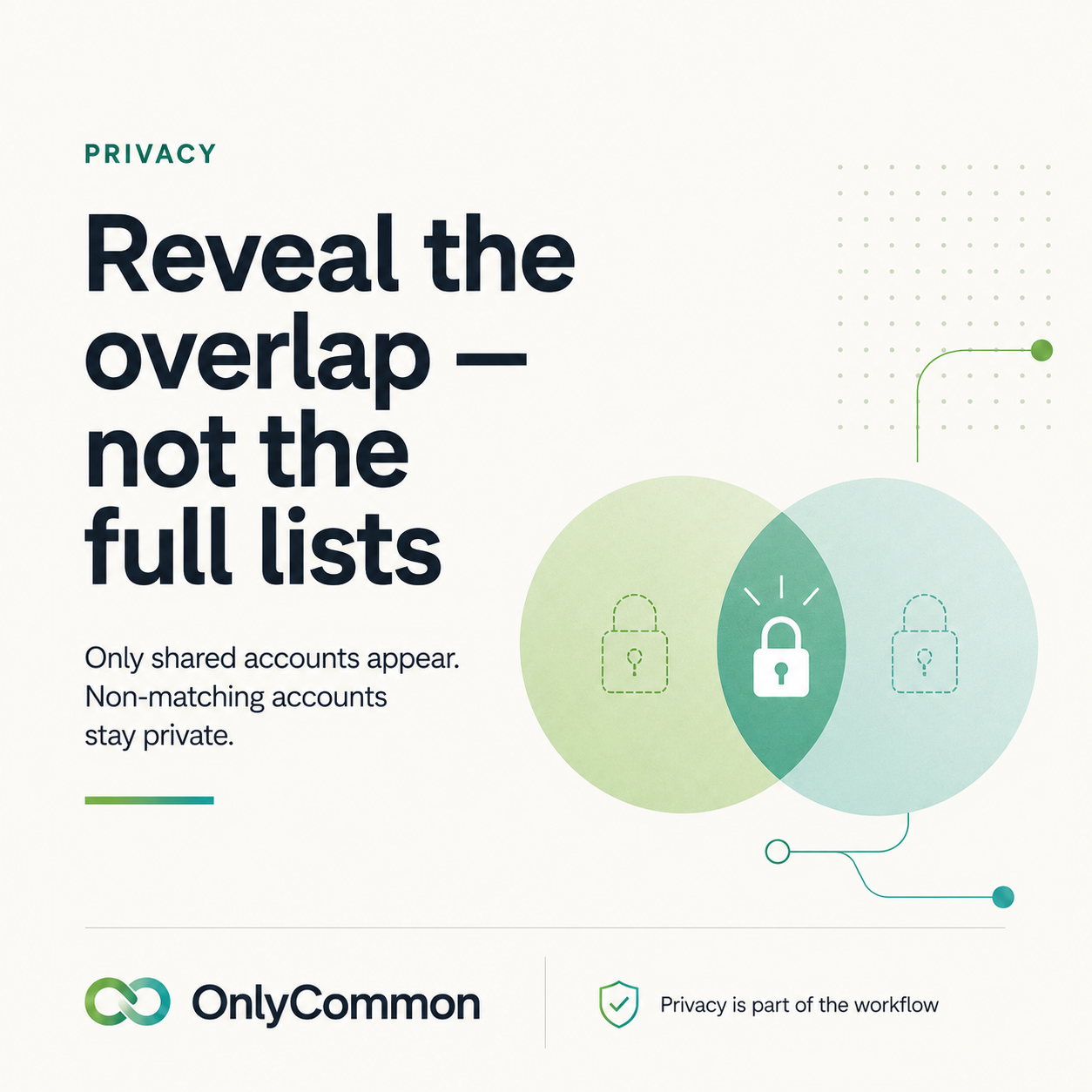
Modern account mapping tools support this natively — each side uploads a list independently, only overlapping accounts are revealed, and non-matching accounts remain private. Matching typically uses DUNS, VAT or registration number, domain, company name, and country-aware logic. Raw uploads are deleted within about 24 hours and reports expire within about 30 days.
Writing this into the agreement dramatically shortens the data-sharing clause: you're not exchanging customer lists, so you don't need heavy processing-terms language for data that never crosses the boundary. See OnlyCommon's privacy approach and how it works.
12. Co-selling rules and joint deal execution
How joint deals are worked in practice — introductions, joint calls, technical validation, joint proposals, mutual updates, and escalation paths. Reference an operating cadence exhibit rather than baking it into the contract.
13. Customer contracting
Which party contracts with the customer. In a co-sell, each side contracts directly for its own product. In a reseller motion, the reseller may contract on its own paper or on the vendor's paper. State it clearly to avoid ambiguity in front of the customer.
14. Information sharing between competitors
If the two companies compete in adjacent segments, restrict what can be shared to what's necessary for the partnership and prohibit use for competitive analysis, prospecting non-shared accounts, or training internal models on the other side's data.
15. Confidentiality
Standard mutual confidentiality covering exchanged information — customer data, pipeline, roadmap discussed in joint planning, commercial terms. Reference an existing MNDA if you have one.
16. Security
Baseline security expectations: certifications either party maintains, incident notification, sub-processor management if any personal data is exchanged. Keep it proportionate to the data actually shared.
17. Intellectual property
Each party retains its own IP. No transfer, no license beyond what's necessary to perform under the agreement. Joint IP (rare in commercial partnerships) needs its own careful clause.
18. Trademarks and brand use
Logo and mark usage, approval process, revocation on termination. Default to mutual written approval before public use.
19. Marketing
What joint marketing is permitted — case studies, press releases, joint content — and who approves it. Include an opt-out for either party from a specific asset without terminating the whole agreement.
20. Product claims
Restrictions on what each party may claim about the other's product. Especially important when one side is technical and the other is a reseller or agency.
21. Training and certification
Requirements for enablement, certification of the partner's staff, and access to the vendor's training resources. Scale this to the motion — a co-sell pilot needs a single enablement session, not a certification program.
22. Support obligations
Who supports the customer for what. If the partner is delivering implementation or first-line support, define the boundary and escalation paths.
23. Performance expectations
Quotas, activity targets, pipeline commitments, or forecast obligations. Realistic and staged — heavy performance clauses in a pilot agreement usually poison the relationship.
24. Reporting
What each side reports to the other, in what format, on what cadence. Sourced and influenced pipeline, joint activities, executive updates.
25. Compliance
Anti-bribery, anti-corruption, sanctions, and applicable local regulation. Standard clauses that legal counsel will supply.
26. Warranties
Mutual warranties on authority to sign, legal capacity, and no conflicting agreements. Product or service warranties belong in the underlying customer contract, not the partnership agreement.
27. Indemnities
Mutual indemnification for third-party claims arising from each party's own breach, own IP, or own conduct. Carve out gross negligence and willful misconduct from any limitation of liability.
28. Limitation of liability
A cap and exclusions of indirect and consequential damages. Sized to the commercial reality of the partnership.
29. Insurance
Minimum insurance either party carries — general liability, professional indemnity, cyber — where the relationship justifies it.
30. Term
Initial term (12 months is common) and renewal mechanics. Auto-renewal is common but signal it clearly.
31. Termination
For convenience (30–90 days' notice) and for cause (material breach with cure period, insolvency, change of control). Termination for convenience should almost always be mutual.
32. Post-termination
What happens to open joint opportunities, shared data, trademark use, and confidentiality obligations after termination. Shared account data should be deleted; open joint opportunities usually continue under the terms in force when the deal was created.
33. Dispute resolution
Escalation ladder — commercial contacts, then executives, then formal process — before litigation or arbitration.
34. Governing law and jurisdiction
The law that governs the agreement and where disputes are heard.
35. Boilerplate
Notices, assignment, entire agreement, severability, force majeure, waiver, counterparts.
The privacy-first account mapping clause
Because so much of a partnership agreement turns on data sharing, it's worth calling out the specific approach that keeps this clause short and safe:
Each party will upload its own account list independently to a mutually agreed privacy-preserving account-mapping tool. The tool will reveal only accounts that appear on both parties' lists ("Shared Accounts"). Non-matching accounts of either party will not be disclosed to the other. Shared Account data may be used solely for joint go-to-market activity under this Agreement, and may not be used for competitive analysis, prospecting non-shared accounts, or training internal models. Raw uploads shall be deleted within twenty-four (24) hours of processing; overlap reports shall expire within thirty (30) days.
That single clause replaces most of what would otherwise be a lengthy customer-data exchange section, because non-matching customer lists never leave either company.
A copyable checklist
Use this as a section-by-section check before signing.
- Parties, effective date, signing authority
- Purpose
- Scope (segment, geography, product, motion)
- Relationship status (independent contractors, not a legal partnership)
- Roles and responsibilities
- Authorization limits
- Exclusivity or non-exclusivity
- Commercial model
- Lead qualification and registration
- Account ownership and conflict rules
- Account mapping and data sharing (minimum necessary disclosure)
- Co-selling rules and joint deal execution
- Customer contracting
- Information sharing between competitors
- Confidentiality
- Security
- Intellectual property
- Trademarks and brand use
- Marketing
- Product claims
- Training and certification
- Support obligations
- Performance expectations
- Reporting
- Compliance
- Warranties
- Indemnities
- Limitation of liability
- Insurance
- Term
- Termination (convenience and cause)
- Post-termination
- Dispute resolution
- Governing law and jurisdiction
- Boilerplate
Don't over-contract the pilot
The single highest-leverage rule: the pilot agreement should match the maturity of the relationship. A global rollout contract before there's evidence of a working motion is what kills otherwise good partnerships. Start narrow, validate the overlap privately, run a scoped pilot under a light agreement, and expand the contract once the business case is proven.
OnlyCommon makes the data-sharing clause easy: each side uploads independently, only shared accounts are revealed, and non-matching accounts stay private. Map a partner free, or read how it works and our privacy approach.
FAQ
Is this legal advice? No. This guide is educational. Have qualified counsel review any agreement before you sign it.
Do we need a full agreement to start account mapping? Usually a mutual NDA plus a privacy-first mapping tool (which reveals only shared accounts) is enough to run a first mapping session. Move to a fuller agreement once you decide to run a pilot.
How is this different from a partnership entity or founder agreement? Very different. This is a commercial contract between two independent companies. A partnership entity or founder agreement forms a legal entity or governs founder relationships in a single business.
How long should a first pilot agreement be? Two to three pages is common — parties, scope, roles, data sharing, confidentiality, term (60–90 days), termination, boilerplate. See the co-selling agreement template.
Do we need exclusivity in a first agreement? Almost never. Exclusivity is expensive to grant, hard to enforce, and hard to reverse. Save it for a mature, validated partnership where both sides have real reason to commit.
Validate the partnership before you invest in it.
Compare account lists privately, identify the real opportunity, and build the business case before integrating systems.